
This post is also available in:

Where do we encounter the sacramental outside the church walls, and how does routine obligatory work transform into lived contemplation?
There is a secret contempt for the everyday that has taken root even in pious circles. We tend to divide life neatly into two spheres: here, spiritual time—prayer, worship, the reading of sacred texts, the great theological conversation; there, profane time—going to work, washing the laundry, shopping, tidying up, washing the dishes.
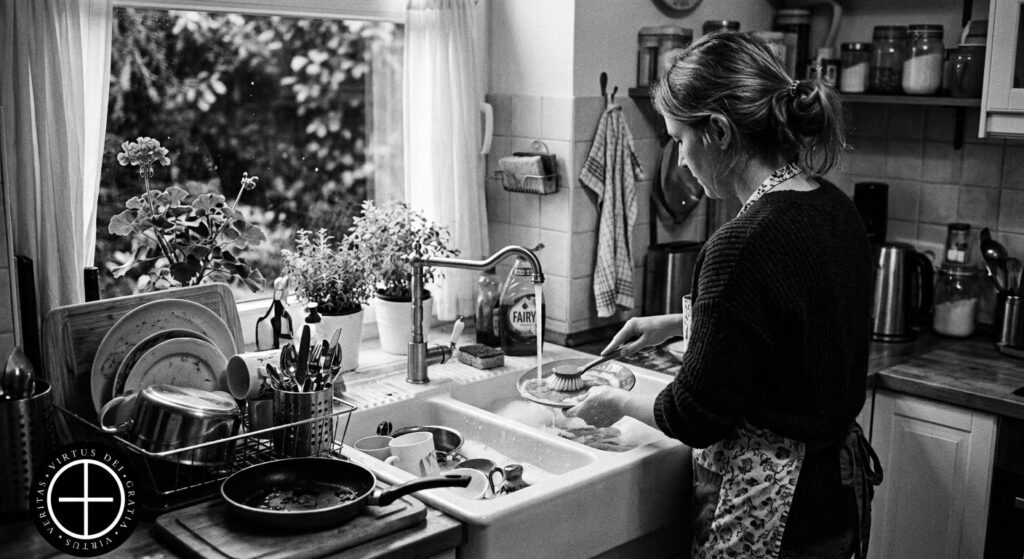
In this division, housework appears as a necessary evil, a time-consuming delay of actual life. One performs it hastily, with a distracted mind, mentally already at the next book, the next problem, or in the digital ether. Whoever lives this way banishes God from the majority of their waking hours. They turn the world into a secular prison from which they are only allowed to escape for one hour on Sundays.
But Christianity is not a religion of escape. It does not begin in the ether, but in the flesh, in the stable, in the wood of the carpenter’s workshop, and in the dust of the Galilean roads. If the Incarnation is true—if God actually became man—then there is no longer a square inch of reality that must fundamentally be godless.
The Resistance of Matter
Whoever stands before the sink encounters reality in its purest, unvarnished form. Greasy plates, burnt pots, cold leftovers: here there are no abstractions. Matter offers resistance. You cannot sugarcoat things; you have to touch them.
In the modern world, we have become accustomed to consuming reality through screens—smooth, frictionless, interchangeable with a swipe. Dishwashing refuses this convenience. It demands warm water, soap, a brush, and above all: time and physical effort.
Gabriel Marcel emphatically warned against the temptation to reduce existence to having—to the accumulation of functions, possessions, and abstract achievements. Being, on the other hand, opens up where the person is present, where they expose themselves to the situation. Washing a plate is a school of being: it forces the person into the here and now. You cannot wash this plate in yesterday and not in tomorrow. You wash it now.
The Liturgy of the Recurring
We often struggle with repetition. No sooner is the table cleared than the next meal is imminent; no sooner is the sink empty than it fills anew. This cycle can be perceived as senseless Sisyphus work—or as liturgy.
What else does the Church do in its times of prayer than repeat the constant? Day after day the same psalms, week after week the same petitions, year after year the same liturgical cycle. Repetition is not a deficiency, but the rhythm of life. It grinds down the edges of the ego. It takes away the illusion that we must reinvent the world with every move.
Brother Lawrence of the Resurrection, the simple 17th-century Carmelite brother, found God in the midst of the pots and pans of the monastery kitchen:
“The time of business does not with me differ from the time of prayer; and in the noise and clatter of my kitchen, while several persons are at the same time calling for different things, I possess God in as great tranquility as if I were upon my knees before the Blessed Sacrament.”
BoD (Ed.): Brother Lawrence, The Practice of the Presence of God, updated new edition 2026
This is not sentimental romanticism, but an ascetic exercise. It means not just cleaning the pot to get it over with, but treating it with the same care with which a priest folds the purificator. Not because the dishes are holy, but because the service to them is holy.
For Whom We Dip Our Hands Into the Water
No housework happens for itself alone. It always stands in a silent relationship to others. When we wash dishes, we prepare the table for the next person. We create space in which a family can breathe, a guest can be received, or a sick person can be strengthened.
Here, profane duty directly touches the commandment of love for one’s neighbor. In everyday life, charity is rarely a heroic act; mostly it is inconspicuous, unthanked, and invisible. It consists of taking out the trash before it smells, bringing the glass of water to the bedside, wiping the table. Whoever cleans the plate serves life. They hold the order of creation against the chaos that constantly wants to penetrate our homes and souls.
Virtus Dei in Hiding
The power of God (Virtus Dei) rarely shows itself in loud spectacle in the biblical testimonies. It shows itself in the gentle, quiet whistling to the prophet Elijah; it shows itself in the breaking of bread; it shows itself in a bowl of water with which Jesus washes the road dust from the feet of his disciples.
The next time you stand before the sink, when the fatigue of a long day lies on your shoulders and the pile seems insurmountable: do not despise this place. Do not take flight inwardly.
Dip your hands into the water. Take the sponge. Breathe calmly. This place is not abandoned. In the midst of the rising steam, in the rubbing of the cloth, in the silence of this simple service, God is waiting for you to stop fleeing—and simply be there.
